Ecommerce
How to Start Ecommerce Business in Pakistan (2026 Guide)
TL;DR
You can start an ecommerce business in Pakistan with a laptop, the internet, and a clear plan. Pick one model. Check demand before you buy stock. Get your NTN as you grow. Use Payoneer for foreign payouts and cash on delivery for local sales. Put profit back in. Do not borrow to start.
- Pick one model, such as marketplaces, your own store or dropshipping, and master it for six months before adding another.
- Check real sales and confirm your profit after fees and shipping before you buy stock, and avoid fragile or bulky items.
- Start as a sole proprietor with a free NTN from FBR. Move to a private limited company through SECP when revenue grows.
- Take foreign payments through Payoneer and offer cash on delivery to local buyers, because it raises sales.
- Start lean, keep business cash apart from personal cash, reply to buyers fast and never borrow money to start.
The honest 2026 guide to starting an ecommerce business in Pakistan: models, legal setup, payments, products, costs, and marketing.
If you want to learn how to start ecommerce business in Pakistan, you can begin with a laptop, an internet connection, and a clear plan. Thousands of Pakistanis already sell online every day, some to local buyers and some to customers in the US, UK, and Gulf countries. This guide walks you through the full process, from choosing your model to getting your first order, with the legal steps verified against current SECP and FBR procedures. No hype, no shortcuts, just the real path.
Pakistan Ecommerce in Numbers
Three numbers tell you why this is worth doing. In FY25, 93 percent of online purchases in Pakistan were paid through bank accounts or e-wallets, up from 87 percent the year before, according to the State Bank of Pakistan Payment Systems Review reported by ProPakistani. That is 684 million ecommerce transactions through digital channels versus only 52 million by card.
Market size estimates for 2025 range from roughly USD 6.5 to 7 billion in SBP based industry estimates to USD 14.11 billion in the Research and Markets databook, with annual growth around 25 to 30 percent. And industry estimates put cash on delivery at 55 to 65 percent of orders, with over 80 percent of orders placed from mobile phones. The demand is real, it is growing, and it is mobile first.
What Starting an Ecommerce Business in Pakistan Actually Means
Ecommerce simply means selling products through the internet instead of a physical shop. In Pakistan, that breaks into three practical models. Picking the right one at the start saves you months of wasted effort, so understand each before you spend a single rupee.
| Model | How it works | Best for |
|---|---|---|
| Sell on international marketplaces | You list products on platforms like eBay, Amazon, or Etsy and sell to foreign buyers | Beginners who want built in traffic without building a website |
| Run your own online store | You build a store on Shopify or WooCommerce and bring your own visitors | People who want full control over branding and customer data |
| Dropshipping | You list products you do not own; a supplier ships directly to your buyer | Starters with almost no capital who want to test products fast |
Every model needs the same foundations: a legal identity, a way to receive payments, reliable products, and a plan to reach buyers. The rest of this guide builds those foundations one step at a time.
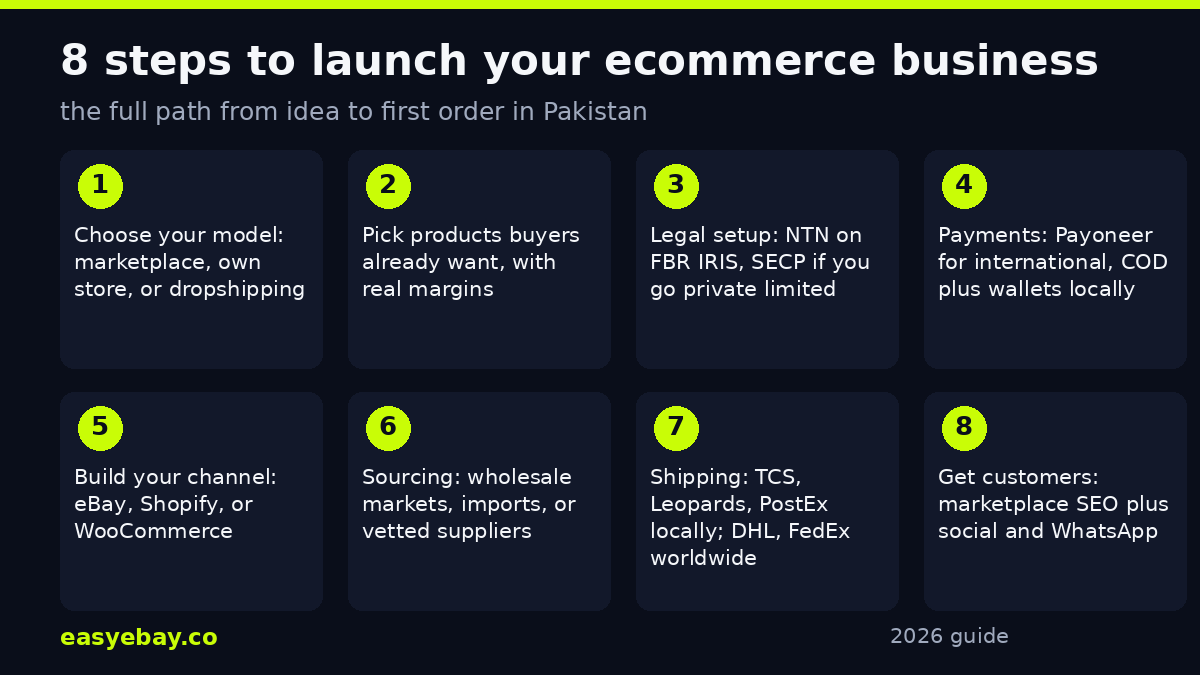
What Are the 8 Steps to Start an Ecommerce Business in Pakistan?
To start, pick one model and master it. Find a product with real demand. Get your NTN from FBR. Set up Payoneer for foreign payouts, or cash on delivery for local buyers. Build your store or marketplace channel. Line up sourcing and shipping. Then bring in free traffic till orders come. Each step below shows how.
Step 1: Choose the Model That Fits Your Situation
Be honest about your starting position, because it decides how to start ecommerce business in Pakistan the right way for you. Your capital, your skills, and your patience decide which model works for you.
International marketplaces suit you if you want sales without learning website design or paid advertising first. Platforms like eBay already have millions of buyers searching every day. Your job becomes product research, good listings, and reliable fulfillment. The tradeoff is fees on every sale and rules you must follow.
Your own store suits you if you think long term. A Shopify or WooCommerce store is an asset you own. Nobody can suspend your entire business overnight the way a marketplace can restrict an account. The tradeoff is that zero visitors arrive on their own. You must learn to bring traffic through social media, search, or ads.
Dropshipping suits you if your budget is close to zero. You test products without buying stock. When an order arrives, your supplier ships it. The tradeoff is thin margins and full responsibility when the supplier makes a mistake, because the buyer blames you, not the supplier.
Most beginners in Pakistan do best starting with one model and mastering it for six months before adding a second. Spreading yourself across three models at once is how people quit in month two.
Step 2: Decide What to Sell
This is where most new sellers fail. They pick products they personally like instead of products buyers actually want. Flip that around.
Start with demand, not with the product. Ask three questions about anything you consider selling:
- Are people already buying this online? Check marketplaces for active listings and recent sales, not just listed prices.
- Can you source it reliably at a price that leaves profit after fees, shipping, and taxes? Work the math before you order anything.
- Is it simple to ship and hard to break? Fragile, oversized, or expiry dated products create returns that eat beginners alive.
Winning beginner categories share the same traits: steady everyday demand, low return rates, simple shipping, and enough margin to survive mistakes. Avoid chasing viral trends as your first product. Trends spike and die, and beginners usually arrive right when the spike ends.
Write down ten product ideas, score each against the three questions above, and start with the highest scorer. Product research is a skill you sharpen forever, so treat your first pick as practice, not as a final decision.
Step 3: Handle the Legal Side Before You Scale
You do not need a registered company to make your first sale, but you do need proper paperwork before money starts flowing regularly. Pakistan gives you two common structures.
| Structure | What it is | Cost and effort | Best for |
|---|---|---|---|
| Sole proprietorship | You and the business are legally the same person | Free NTN registration on the FBR IRIS portal; fast | Freelancers and small starters testing the waters |
| Private limited company | A separate legal entity registered with SECP | Government fees start around PKR 1,000 and rise with authorized capital; takes a few working days online | Serious stores, partnerships, and anyone taking outside investment |
For a sole proprietorship, the practical path is: create an account on the FBR IRIS portal, complete the registration form with your CNIC and a biometrically verified SIM in your own name, upload a recent utility bill as address proof, and download your NTN certificate once approved. For an individual, your CNIC number functions as your NTN. Registration itself is free.
For a private limited company, the path runs through SECP: create an account on the SECP eServices portal, reserve your company name, prepare your Memorandum and Articles of Association, upload CNIC copies of directors, pay the fee based on your authorized capital, and receive a digital Certificate of Incorporation. There is no minimum paid up capital required for a private limited company under the Companies Act 2017. After incorporation, register with FBR for your NTN and open a corporate bank account.
Practical advice: start as a sole proprietor, and move to a private limited company when monthly revenue justifies it. Do not let paperwork become an excuse to delay your first listing. And keep records from day one. Every purchase, every fee, every payout. Clean books save you during tax season.
Step 4: Set Up a Way to Receive Payments
Your payment setup depends on who you sell to.
Selling to Pakistani buyers: cash on delivery still dominates local ecommerce, and bank transfers through local banks work for higher value orders. Mobile wallets are widely used for smaller payments. If you run your own store for local buyers, offering cash on delivery will raise your conversion rate more than any design change.
Selling to international buyers: you need a method that receives foreign currency and moves it into your Pakistani bank account. Payoneer is the standard route for Pakistani online sellers, giving you receiving accounts that marketplaces and clients can pay into, with withdrawal to local banks. Set this up early, because payout verification can take days and you do not want your first earnings stuck while documents are pending.
| Factor | Selling to Pakistani buyers | Selling to international buyers |
|---|---|---|
| Main payment method | Cash on delivery, bank transfer, mobile wallets | Payoneer, withdrawn to your local bank |
| Shipping | Local couriers like TCS, Leopards, PostEx | Express (DHL, FedEx) for speed, Pakistan Post for economy |
| How buyers trust you | Cash on delivery as the trust bridge | Tracking numbers and platform reviews |
Whatever you choose, keep business money separate from personal money. Open a dedicated bank account for the business as soon as you have your NTN. Mixing funds makes profit tracking impossible and tax filing painful.
Step 5: Build Your Selling Channel
If you chose marketplaces, your setup work is mostly account creation done right. On eBay, register a seller account, verify your identity, connect Payoneer for payouts, and learn the listing format before you list anything for sale. Our guide on how to sell on eBay from Pakistan walks through the complete setup. Read the platform rules for dropshipping and product restrictions first. Most early suspensions happen because new sellers skip this reading. If your buyers are inside Pakistan, check whether eBay delivers in Pakistan so you promise realistic delivery timelines.
If you chose your own store, you have two serious options. Shopify gives you a hosted store with no technical maintenance. You pay a monthly fee, pick a theme, add products, and start selling the same day. WooCommerce is a free plugin for WordPress that you host yourself. It costs less per month but needs you to handle hosting, updates, and security.
| Option | Monthly cost (approx) | Technical skill needed | Best for |
|---|---|---|---|
| Shopify | Paid plans start around $30 to $40 a month | Almost none | Beginners who want to launch fast |
| WooCommerce | Hosting roughly $5 to $15 a month plus a domain | Basic WordPress comfort | Sellers who want low running costs and full control |
| eBay seller account | Free to start, fees per sale | Almost none | Selling to US and UK buyers from day one |
Whichever you pick, invest in presentation. Clear product photos on plain backgrounds, titles that say what the product is, and descriptions that answer the questions a buyer would ask. On your own store, add a simple returns policy and visible contact information. Trust is the currency of online selling, and new stores earn it through transparency.
Step 6: Sort Out Sourcing and Inventory
You need a reliable way to get products. Pakistani sellers commonly use three routes.
Local wholesale markets. Every major city has wholesale markets for clothing, electronics accessories, cosmetics, and household goods. Visit in person, compare five suppliers minimum, and negotiate on quality first and price second. A cheap supplier whose stock arrives damaged is the most expensive supplier you will ever use.
Importing. For products unavailable locally, many sellers import from China through sea or air cargo consolidators. This needs more capital and patience, since shipping takes weeks, but margins are often better. Start small with one test shipment before committing serious money.
Dropshipping suppliers. You sell first and your supplier ships after each order. This removes inventory risk but demands strict supplier vetting. Order samples to your own address before you list anything. If the sample is poor, your customers would have received the same poor product.
| Sourcing route | Capital needed | Main risk | Best for |
|---|---|---|---|
| Local wholesale markets | Low to medium | A cheap supplier whose stock arrives damaged | Sellers near major city markets who can visit in person |
| Importing from China | Higher, start with one test shipment | Shipping takes weeks and capital stays tied up | Better margins once a product is validated |
| Dropshipping suppliers | Almost none | Supplier mistakes become your refunds | Testing products without buying inventory |
Whatever route you choose, keep backup suppliers. A store that depends on one supplier stops earning the day that supplier has a problem.
Step 7: Plan Shipping and Delivery
Shipping decides whether your business feels professional or chaotic.
For local orders inside Pakistan, private couriers like TCS, Leopards, and PostEx cover the country with cash on delivery collection. Compare their rates for your parcel weight, check their coverage in smaller cities, and confirm how fast they return undelivered cash to you. Late cash returns quietly strangle new sellers.
For international orders, express couriers like DHL and FedEx move parcels in days but cost real money, so they suit higher value products. Pakistan Post offers economical international parcels for lighter items where the buyer accepts slower delivery. Always upload tracking numbers the same day you ship. Tracking is what separates a trusted seller from a suspicious one in the eyes of both buyers and platforms.
Pack every order like it will be thrown. Because in transit, it will be. Good packaging costs little and prevents the returns that destroy beginner margins.
Step 8: Get Your First Customers
Traffic is a skill, not luck. Start with the channels you can run for free.
If you sell on marketplaces, your traffic comes from search inside the platform. Learn how buyers search, write titles with the words they actually type, and keep your prices competitive while protecting margin. Good reviews compound. Your first twenty sales matter more than your next two hundred, because early feedback decides your visibility.
If you run your own store, social media is your storefront window. Short videos showing your product in real use outperform polished ads for new stores. Post consistently on the platforms your buyers actually use, answer every comment, and move conversations to WhatsApp Business for closing sales. WhatsApp catalogs and broadcast lists are quiet workhorses of Pakistani ecommerce.
Content also compounds. A simple blog answering buyer questions brings free search traffic month after month. That is exactly why established sellers publish guides instead of only running ads.
Start with one traffic channel and get good at it before adding a second. Ten half learned channels produce zero sales.
How Much Does It Cost to Start an Ecommerce Business in Pakistan?
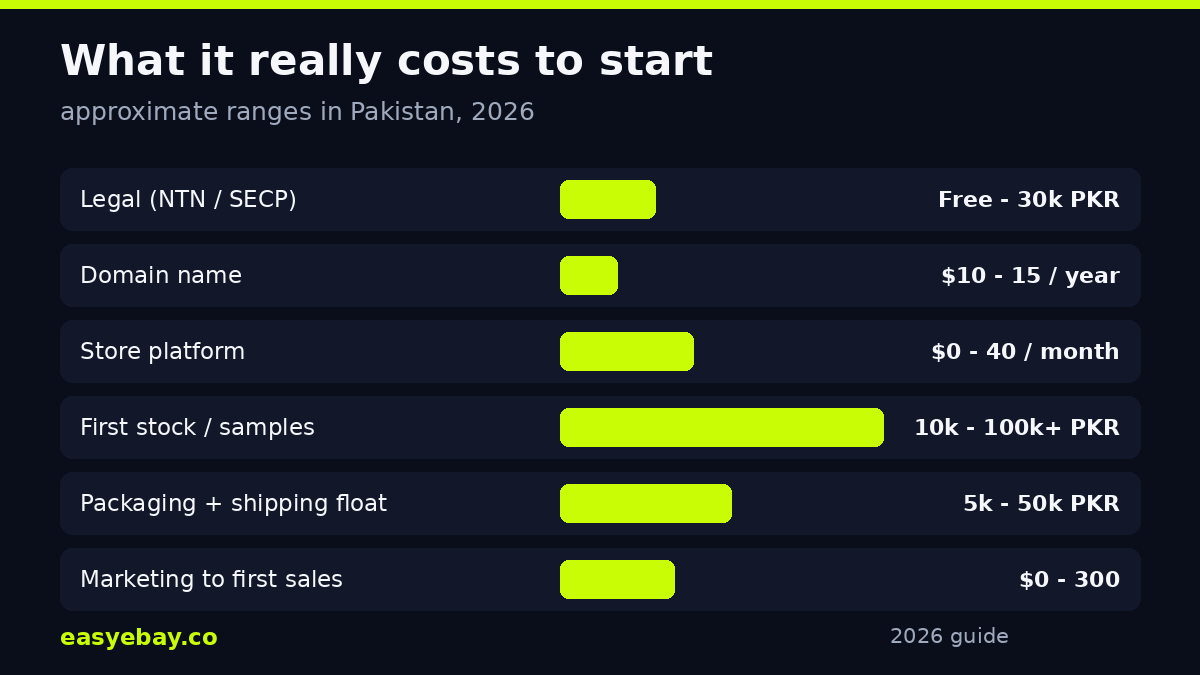
A lean start costs about PKR 15,000 to 45,000. That covers samples, packing, a domain, and a shipping float. Sell on marketplaces and use free marketing. A serious start with Shopify and real stock needs PKR 150,000 or more. Legal setup is free for an NTN and up to PKR 30,000 for a private limited firm.
Honest numbers, marked as approximate because prices change. Whether you are working out how to start ecommerce business in Pakistan on a shoestring budget or with serious capital, you can start leaner or spend more, but this is the realistic shape of it.
| Item | Lean start (approx) | Serious start (approx) |
|---|---|---|
| Legal (NTN / SECP) | Free to around PKR 1,000+ | PKR 5,000 to 30,000+ with professional help |
| Domain name | $10 to $15 per year | $10 to $15 per year |
| Store platform | $0 (marketplace or WooCommerce) | $30 to $40 a month (Shopify) |
| First stock or samples | PKR 10,000 to 30,000 | PKR 100,000+ |
| Packaging and shipping float | PKR 5,000 to 10,000 | PKR 20,000 to 50,000 |
| Marketing to first sales | $0 (organic only) | $100 to $300 test budget |
The lean column is real. Many sellers start with a marketplace account, a small test batch of stock, and organic marketing. Do not borrow money to start an ecommerce business. Start small, reinvest profit, and grow at the speed of your learning.
What Mistakes Kill New Ecommerce Stores?
New stores die from five mistakes you can avoid. Do not copy listings word for word. Do the math on fees and shipping. Reply to buyers fast. Do not run paid ads till your page sells on its own. And do not quit in month three. Fix these five and you beat most new sellers.
Copying listings word for word. Buyers and platforms both punish duplicate content. Write your own titles and descriptions.
Ignoring the math. If fees, shipping, and returns leave you two percent margin, you do not have a business. You have a hobby that loses money.
No customer replies. Answering messages late loses sales you already earned. Reply fast, especially in your first months.
Scaling ads before the basics work. If your product page does not convert organic visitors, paid traffic just burns money faster.
Quitting at month three. Almost every working seller went through a slow start. The ones who kept improving their listings, products, and service are the ones still selling.
Frequently Asked Questions
Pakistani starters ask these questions most. How much cash do you need? Must you register before sale one? Shopify or WooCommerce? How do you get paid from abroad? Is cash on delivery a must? How long till profit? Can you run a store with a job or studies?
How to start ecommerce business in Pakistan with no money?
You can start with very little by selling on marketplaces with no monthly fees and using organic marketing. But zero budget is a myth. You still need product samples, packaging, internet, and a float for shipping. Plan for a small starting budget even in the leanest model.
Do I need to register my business before my first sale?
No. Make your first sales as an individual, then register. Get your NTN from FBR once money flows regularly, and consider SECP registration as a private limited company when the business grows serious.
Which is better for beginners in Pakistan, Shopify or WooCommerce?
Shopify if you want to launch today with no technical work. WooCommerce if you want lower monthly costs and do not mind basic WordPress maintenance. Both work. Your products and marketing matter far more than the platform.
How do I receive payments from international buyers?
Payoneer is the standard route for Pakistani sellers, letting you receive foreign currency and withdraw to local banks. Set it up and verify it before your first payout is due.
Is cash on delivery still necessary for Pakistani customers?
For local buyers, yes in most categories. Cash on delivery remains the trust bridge for customers buying from a new store. Offer it, but track undelivered rates closely.
How long before an ecommerce business becomes profitable?
There is no fixed timeline. Sellers who research products properly, keep costs lean, and improve steadily often see their first consistent profit within a few months. Sellers who skip research and overspend on ads can lose money for a year. Your process decides your timeline.
Can I run an ecommerce business while studying or working a job?
Yes, and most beginners do exactly that. Start with a model that fits your hours, automate what you can, and reinvest early profit. Many full time sellers began as part timers.
Further Reading
Want to learn more? These guides cover the next steps for Pakistani sellers. One shows how to open an eBay seller account from Pakistan with Payoneer payouts. The other explains if eBay ships to Pakistan and how long it takes to arrive.
- How to Sell on eBay from Pakistan — setup, Payoneer payouts, fees, and shipping, step by step.
- Does eBay Deliver in Pakistan? — delivery options, timelines, and what buyers can expect.
- EasyEbay Blog — more guides on how to start ecommerce business in Pakistan and grow.
Free Download
Payoneer And eBay Setup Checklist
24 simple steps to open, verify and link your accounts the right way. Free PDF, made by Asad.
Want Help With Your Store?
Book a free call with Asad Shahzad.
Book A Free Call
Asad Shahzad | Founder and Mentor
Asad Shahzad is the Co Founder and Co Mentor of EasyEbay. He helps store owners manage accounts and grow sales.
Read more from Asad ShahzadRelated Topics
How Much Can You Earn in Pakistan from Walmart, Temu, Shopify, TikTok Shop and Vinted?
There is no fixed monthly income on Walmart, Temu, Shopify, TikTok Shop or Vinted, and from Pakistan some of these platforms are not even open to you yet. This guide shows what your earnings really depend on, how to estimate an honest number for yourself, and why big sales screenshots prove so little.
How to Handle Customer Messages Like a Pro (With Reply Templates)
Learn how to handle customer messages on eBay, Amazon, Etsy and other marketplaces with simple rules, a daily routine, and polite reply templates you can copy.
Daraz vs eBay, Amazon and Other Marketplaces: Where Should Pakistani Sellers Sell?
Is eBay better than Daraz for Pakistani sellers? An honest comparison of Daraz, eBay, Amazon, Walmart, Etsy, Shopify, TikTok Shop, Temu and Vinted, covering buyers, fees, payments and who can join.