Ecommerce
What Does an Ecommerce Manager Do? Roles, Skills & Daily Tasks
TL;DR
- A store lead owns outcomes across six buckets: product list, pricing, stock, shipping, buyer care, and data.
- Turn sales targets into traffic × conversion × average order value, then work backward.
- Watch conversion rate and on time shipment rate daily, and review the full KPI set weekly.
- Give 80% of your effort to the 20% of products, channels, and problems that drive results.
- Write it all down: checklists and briefs beat memory every time.
A practical, no fluff breakdown of the ecommerce manager role: daily tasks, skills, KPIs, salary ranges, and career path, written for sellers and aspiring managers alike.
If you have ever searched what does an ecommerce manager do, you are asking about one key person. That person keeps an online store running and growing every single day.
An ecommerce manager owns the website as a business. They own the product list, prices, deals, stock flow, order shipping, buyer care, and the numbers behind it all. They are part marketer, part ops lead, and part analyst.
In small stores, one person wears all three hats. In large firms, the lead works with a team of specialists in each area. This guide breaks down the role as it works in real life. It covers the tasks, the skills, the KPIs, and the career path, so you know what the job involves.
What Does an Ecommerce Manager Do?
An ecommerce manager runs the whole online store. That covers product listings, prices, deals, stock, order shipping, buyer help, and score reports. They sit between the ad team, the warehouse, and the store's top team. Their job is to make sure the site turns visits into sales, ships orders on time, and grows sales month after month.
The honest answer to what does an ecommerce manager do is that they own outcomes, not tasks alone. A product uploader adds listings. An ecommerce manager makes sure those listings sell. Their core duties fall into six buckets.
First, the product list and how goods are shown. This means making and tuning product pages, writing titles and product text, sorting goods into groups, and keeping images and variants right. Second, prices and deals. This means setting prices, running discounts and coupon drives, and planning sales for each season.
Third, stock. This means watching stock levels, setting reorder points, and working with suppliers so bestsellers never run out. Fourth, shipping. This means making sure orders are packed, shipped, and tracked on time. It does not matter if the store ships in house or through a third party shipping firm.
Fifth, buyer care. This covers hard support cases, replies to reviews, and returns. Sixth, data and reports. This means tracking traffic, sales rates, and sales, then turning those numbers into a weekly action plan. In a small store, the lead does all of this in person. In a larger store, they direct a team of specialists. Either way, they still answer for how the store does.
What Is the Role of an Ecommerce Manager in a Growing Store?
In a growing store, the lead's role shifts. They move from doing it all to directing it all. They turn sales targets into weekly plans. They decide where time and cash go. They work with the ad, warehouse, and support teams. And they answer for the online channel's profit and growth.
Think of it this way: a helper works through a task list, while a lead owns a number. If the store needs Rs 5,000,000 in sales each month, the lead breaks that into three parts. Those parts are traffic × conversion rate × average order value. Then they work backward.
That math drives the ad budget, the deals plan, and the stock plan. The role is also the hub for all talks. The ad team wants discounts. The warehouse wants steady volumes. Suppliers need lead times. The top team wants margin.
The lead weighs these competing demands and makes the final call. As stores grow, this team work is worth more than any one hands on skill. Picking what matters most, saying no to low impact ideas, and keeping each team on the same weekly targets is what scales a store.
What Are the Key Steps in the Ecommerce Business Process?
The online sales process runs in a loop. It starts with finding products and building the product list. Then comes setting prices and driving traffic. Next the store takes orders, packs and ships them, and helps buyers. It handles returns and checks results. Then the next loop starts stronger. Each step feeds the next. Weak links drain profit in silence.
Every step needs an owner. Most times, that owner is the store lead. The table below maps each step to what happens and where the lead adds value.
| Step | What happens | The manager's job |
|---|---|---|
| 1. Sourcing | Finding products and making deals with suppliers | Picking lines, checking supplier terms, signing off margins |
| 2. Product list setup | Making product pages with images and copy | Writing listings, setting groups, variants, and SEO fields |
| 3. Pricing | Setting retail prices and discount rules | Rival price checks, margin math, deals plan |
| 4. Marketing | Driving traffic via ads, SEO, email, social | Budget split, campaign briefs, content plan |
| 5. Order processing | Taking payment and confirming orders | Watching failed payments, fraud flags, order errors |
| 6. Fulfillment | Picking, packing, and shipping | Carrier choice, packing rules, tracking updates |
| 7. Buyer support | Answering questions and solving issues | Hard cases, reply time targets, help center content |
| 8. Returns | Taking back and refunding returned goods | Returns policy, checks on goods, refund speed |
| 9. Review | Checking sales, costs, and buyer data | Weekly reports, spotting winners and losers, next steps |
Note that steps 5 through 8 are where most stores lose cash in silence. Late shipments, slow refunds, and tickets with no reply add up fast.
A good lead watches these work steps as closely as ads. A store that markets well but ships badly does not last.
What Does a Typical Day, Week, and Month Look Like for an Ecommerce Manager?
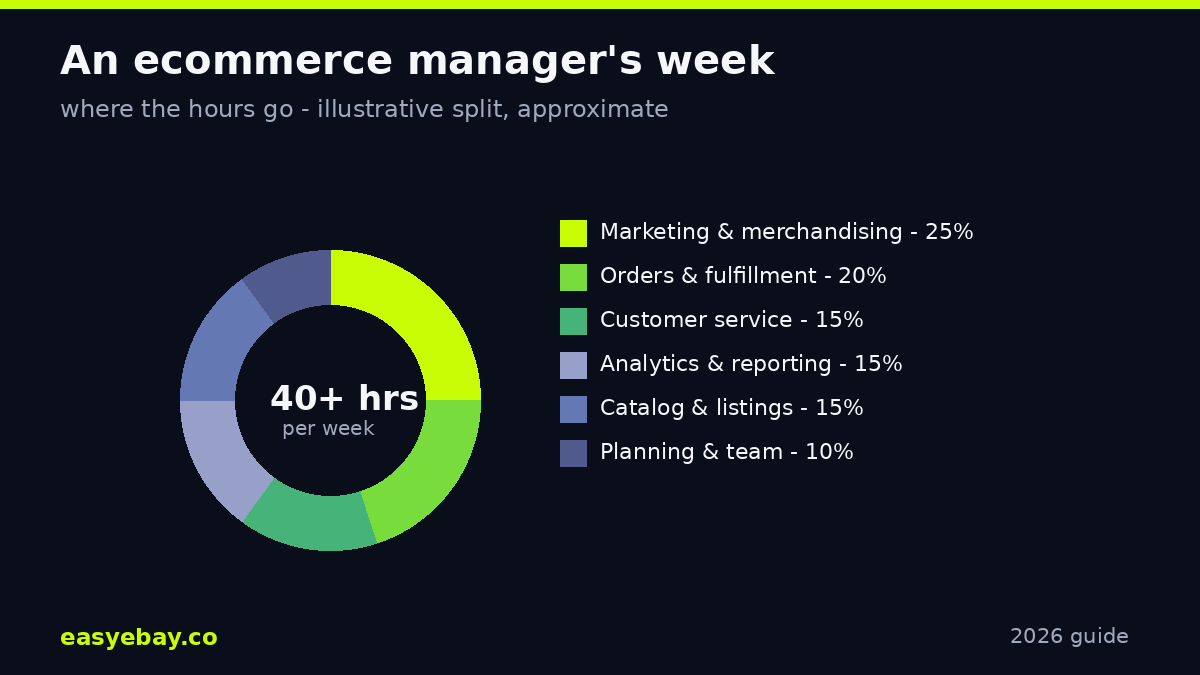
Anyone researching what does an ecommerce manager do usually wants the plain truth about the calendar. The work runs on three rhythms. The first is daily firefighting and order flow. The second is weekly planning and tuning. The third is monthly strategy, budgets, and big picture review. Mastering all three rhythms is what sets leads apart from task doers.
A typical day starts with the numbers. Check yesterday's sales, traffic, ad spend, and any stock or shipping alerts. Midday goes to doing the work: posting listings, briefing campaigns, and answering hard cases. The day ends by queuing tomorrow's top tasks.
Weekly work is deeper. Review what sold and why. Adjust deals. Plan content. Meet suppliers or team members. Monthly work is strategic. Close the month's P&L. Set next month's targets. Review the ad budget. Plan campaigns for the season. The table below shows how the workload splits.
| Cadence | Core tasks | Time share (approx.) |
|---|---|---|
| Daily | Check sales, traffic, and ad dashboards; clear order issues; watch stock alerts; answer hard buyer cases; post planned content | The base routine, every day |
| Weekly | Sales and returns review; deals and email planning; listing tuning; supplier follow ups; team check ins; content plan | Review and adjust, every week |
| Monthly | P&L review; next month's targets and budget; season campaign planning; pricing review; tool and process checks | Strategy and planning, every month |
| Quarterly | Range review (add/drop products); carrier and supplier deal talks; site UX check; skills and hiring gaps | Bigger bets, four times a year |
Global retail ecommerce sales passed $6 trillion in 2024. That is roughly one in five retail dollars worldwide (Statista).
That scale is why the role exists. When a fifth of retail moves through websites, someone has to run those sites with real discipline, not as side projects.
What Skills Are Needed for an Ecommerce Manager?
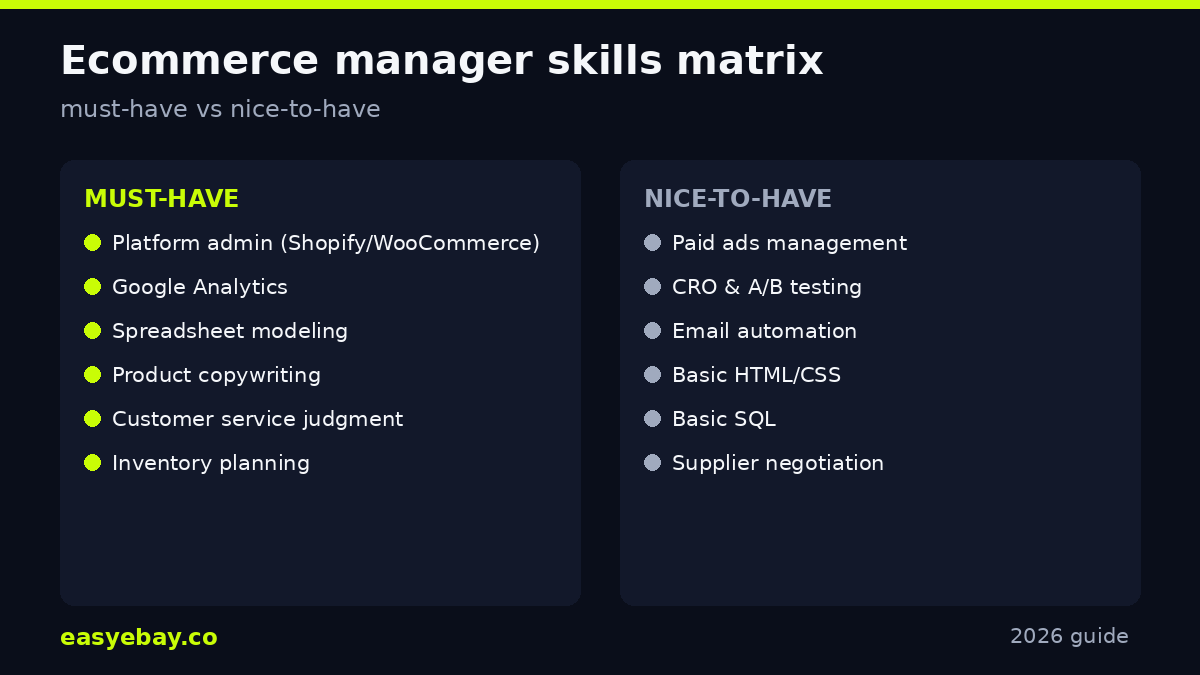
A store lead needs four kinds of skills. Platform skills, such as Shopify or WooCommerce. Data skills, such as analytics and spreadsheets. Trade skills, such as pricing, product display, and copywriting. And people skills, such as buyer empathy, supplier deal talks, and team work.
No one is born with this mix. The table below breaks the skill set into two parts. First, what each skill does for the store. Second, the most hands on way to learn it.
| Skill | Why it matters | How to learn it |
|---|---|---|
| Ecommerce platform admin | The store runs on it; listings, orders, discounts all live here | Build a free trial store on Shopify or WooCommerce and list 20 real products |
| Google Analytics / dashboards | Every call needs numbers behind it | Free Google Analytics course + one practice dashboard |
| Spreadsheet models | Margin math, forecasts, and stock planning live in sheets | Rebuild a store P&L and a reorder tool from scratch |
| Product copywriting | Titles and product text move sales rates | Rewrite 50 live listings and A/B test the results |
| Basic SEO | Product and group pages earn free traffic for years | Tune one group end to end: keywords, meta, in site links |
| Email marketing | Repeat buyers are cheaper than new ones | Set up welcome, abandoned cart, and post purchase flows on a trial store |
| Buyer care judgment | Reviews and tickets shape the brand's good name | Handle 100 real tickets; write macros for the top 20 issues |
| Stock planning | Stockouts lose sales; overstock ties up cash | Track one product's sell through and set reorder points by hand |
| Paid ads literacy | You must brief and judge ad results even if others run ads | Spend a small test budget; learn to read ROAS and CAC reports |
| Basic HTML/CSS | Fixing layout glitches without waiting on a developer | Free HTML/CSS course; practice on product page templates |
For sellers in Pakistan, two skills deserve extra weight. The first is supplier deal talks. Margins are won in sourcing.
The second is cash flow planning. Stock cash is locked up longest in import heavy firms. Both are learned by doing, not by watching courses.
Which KPIs Does an Ecommerce Manager Own?
A store lead owns the numbers that prove the store is healthy. These include conversion rate, average order value, and sales. They also include traffic quality, customer acquisition cost, and return on ad spend. Add cart abandonment, return rate, and repeat purchase rate. If a metric moves the store's profit, the lead answers for it.
Owning a KPI means three things. Know its current value. Know its target. Have a plan to close the gap. The table below gives the formulas and real world target ranges. These are rough figures from widely reported industry benchmarks, 2024 to 2026.
| KPI | Formula | Healthy target (approx.) |
|---|---|---|
| Conversion rate | Orders ÷ visitors × 100 | 2 to 3% for most stores; higher for niche or branded stores |
| Average order value (AOV) | Revenue ÷ orders | Grow 5 to 10% yearly via bundles, upsells, free shipping thresholds |
| Revenue | Sum of completed orders | Steady month over month growth; seasonal peaks planned |
| Customer acquisition cost (CAC) | Marketing spend ÷ new buyers | Below one third of first order gross profit |
| Return on ad spend (ROAS) | Ad sales ÷ ad spend | 3:1 floor for paid social; 4:1+ for search |
| Cart abandonment rate | 1 minus (orders ÷ carts created) | Below 70%; the global average sits near 70% (Baymard Institute) |
| Return/refund rate | Returned orders ÷ total orders | Under 10% for most groups; 20 to 30% is normal for fashion (industry estimates) |
| Repeat purchase rate | Returning buyers ÷ total buyers | 25 to 30%+ within a year for consumables; lower for one time buys |
| On time shipment rate | Orders shipped on time ÷ total orders | 98%+; late shipping is the fastest way to earn bad reviews |
Two numbers deserve a lead's daily focus above all. The first is conversion rate. It shows if the site sells. The second is on time shipment rate. It shows if the store keeps its promises.
Email stays one of the cheapest levers for both new buyers and repeat buyers. Industry studies have found returns around $36 per $1 spent (Litmus) again and again. That is why lifecycle email usually stays in the lead's own hands rather than being outsourced early.
How Do Online Stores Cover the Ecommerce Manager Role?
Stores cover this role in three main ways. They hire an in house ecommerce manager. They contract a freelancer. Or they hand the work to a done for you team. Each option trades off cost, control, availability, and breadth of skill in a different way. The right choice depends on order volume, budget, and how much control the owner keeps.
There is no one right choice for all stores. There is only the right fit for a store's size, budget, and how much day to day control the owner wants to keep. The table below compares the three options on facts.
| Factor | In house manager | Freelancer | Done for you team |
|---|---|---|---|
| Best for | Stores with steady volume that need daily ownership | Short projects, launches, or clear skill gaps | Owners who want the work handled end to end |
| Cost structure | Monthly salary plus perks; fixed cost | Hourly or per project; costs that vary | Monthly retainer or sales share; bundled cost |
| Availability | Full time, focused on one store | Shared across clients; booked ahead | Team cover; not one set person |
| Skill breadth | One person's strengths; gaps need extra hires | Deep in one field (ads, SEO, design) | Broad across tasks; depth varies by firm |
| Control | Full: the owner directs top tasks daily | Medium: set by contract and brief | Lower: run on agreed steps and reports |
| Scaling | Hire more people as volume grows | Add more contractors per field | Usually scales within the current setup |
Stores that ask what does an ecommerce manager do before hiring often learn something. The real question is which parts of the role they want to keep. Many owners keep strategy and supplier ties in house. They hand the doing, listings, ads, support, to outside help.
The deciding factors are honest ones. Order volume. Monthly budget. And whether the owner enjoys hands on work or wants it off their plate for good.
Is Ecommerce Management a Good Career in 2026?
Running online stores is a strong career choice in 2026. It suits people who enjoy mixing numbers, buyers, and day to day work. Online retail keeps taking share from offline. Every brand needs someone to run its store. And the skills transfer across industries, platforms, and countries.
The demand case is clear. Global ecommerce sales passed $6 trillion in 2024 and keep growing as a share of total retail (Statista). Every one of those dollars flows through a website or marketplace listing that someone must manage.
Unlike narrow fields, the role builds a portable toolkit. Data, product display, paid media skills, and day to day work apply to any product group. For Pakistan based pros, there is an added edge. Remote online store roles for US, UK, and Gulf based stores are often advertised.
See Teal's ecommerce manager career path guide for how the role grows over time.
The work is fully doable from Lahore, Karachi, or Islamabad with a good internet link. The table below shows the usual path up. Pay figures are rough ranges seen in 2025 to 2026 job postings.
| Level | Experience | Main duties | Pay (approx.) |
|---|---|---|---|
| Ecommerce executive | 0 to 2 years | Listings, order processing, basic reports, ticket handling | Rs 60k to 100k/month (PK); $40k to 55k/year (US) |
| Ecommerce manager | 2 to 5 years | Owns the store's numbers; pricing, deals, team work | Rs 100k to 200k/month (PK); $60k to 95k/year (US) |
| Senior ecommerce manager | 5 to 8 years | Multi channel or multi store ownership; budget control | Rs 200k to 350k/month (PK); $95k to 130k/year (US) |
| Head of ecommerce | 8+ years | Full P&L, hiring, strategy across channels and regions | Rs 350k to 600k/month (PK); $130k to 180k/year (US) |
People who search what does an ecommerce manager do are often asking one thing. Is the job worth pursuing? The honest answer: it rewards generalists who like owning results. If you want a role where your choices show up in sales charts at once, this is one of the few careers that offers that.
A bad week is clear to everyone. And you do not need a set degree to start.
What Is the 80/20 Rule in Ecommerce?
The 80/20 rule in ecommerce says a small share of products, buyers, and channels makes most of the results. Roughly 20% of products drive 80% of sales. For a lead, it is a tool for picking what comes first. Find the vital few. Give them most of your time, budget, and stock.
Apply it in four places. First, your range. Spot your hero products, usually 10 to 20% of SKUs. Make their pages, images, and stock levels flawless before touching the long tail. Second, marketing. One or two channels drive most profit making sales in most cases. Fund those fully before testing a fifth platform.
Third, buyers. Repeat buyers cost far less to win than new ones. So work on keeping buyers, email, loyalty, post purchase care, deserves weight beyond its budget share. Fourth, problems. A handful of friction points cause most abandoned carts. Slow pages, hard to read shipping info, and missing payment options are the usual culprits. Fix the biggest leak first.
The trap is spending equal time on everything. A lead who gives 80% of effort to the 20% that matters will beat a busier lead who treats all tasks the same.
How Should a Manager Handle Day to Day Ecommerce Operations?
A lead handles daily store work with a fixed routine. Mornings are for numbers and issues. Midday is for doing work and hard cases. A weekly review turns data into next week's plan. Routine beats heroics. Stores run well when the basics happen on schedule.
Here is a practical working rhythm for stores doing 10 to 1,000 orders a day. Each morning, check yesterday's sales, traffic, conversion, and ad spend against target. Scan for stock alerts, failed payments, and shipping issues. Clear any buyer cases older than 24 hours.
Midday is for moving work forward. Post or improve listings. Brief the week's campaign. Review ad creative. Answer supplier messages. End the day by setting tomorrow's top three tasks in writing. Once a week, run a set review. Look at what sold and why. Check which deals worked. Study what the return reasons show. Decide what changes next week.
Once a month, step back further. Review the P&L, the budget, pricing, and the season plan. Two habits set good leads apart from swamped ones. First, write things down. Checklists, macros, and briefs beat memory every time. Memory is not a system. Second, fix root causes, not symptoms. If the same ticket appears ten times, the answer is a better product page, not ten faster replies.
Frequently Asked Questions
What does an ecommerce manager do on a daily basis?
On a daily basis, a store lead checks sales and traffic dashboards. They clear order issues and stock alerts. They handle hard buyer cases. They post or improve product listings. They work with the ad and warehouse teams. And they set the next day's top tasks.
The mix shifts with store size. Small store leads do the work themselves. Leads at larger stores spend more time directing specialists and reviewing their output.
Do I need a degree to become an ecommerce manager?
No set degree is required. Employers look for proof you can run a store. Show a portfolio of listings you improved, campaigns you ran, or a trial store you built and grew. A marketing or business degree helps.
But real store metrics usually beat a diploma alone. Courses in data and ad platforms strengthen an application.
What is the difference between an ecommerce manager and a digital marketing manager?
A store lead owns the whole online store. That includes the product list, pricing, shipping, and buyer care. Marketing is one part of the job.
A digital marketing manager owns only traffic and campaigns across channels. In small firms the roles often merge. In larger ones, the digital marketing manager reports to or partners with the store lead in most cases.
How much does an ecommerce manager earn in Pakistan?
Based on 2025 to 2026 job postings, store leads in Pakistan earn roughly Rs 100,000 to 200,000 per month in most cases. Senior roles reach Rs 350,000 or more.
Remote roles for foreign stores often pay above local ranges. Pay varies with the store's sales, the lead's track record, and whether the role includes team leadership.
What tools does an ecommerce manager use every day?
The daily toolkit usually includes the store platform, such as Shopify, WooCommerce, or Magento. It includes Google Analytics and a spreadsheet app. It includes an email marketing tool, such as Klaviyo or Mailchimp.
It includes an ad platform, meaning Meta and Google Ads. It includes a helpdesk, such as Zendesk, Gorgias, or Freshdesk. And it includes a project tracker, such as Trello, Asana, or Notion.
Can one person manage an entire ecommerce store?
Yes, up to a point. One skilled person can run a store doing dozens of orders a day. The recipe is the platform plus automation, such as email flows and stock alerts, plus freelancers for skilled work like design or ads.
Beyond roughly 100+ daily orders or many channels, support volume and shipping work need at least a small team in most cases.
How long does it take to become an ecommerce manager?
Most people reach a lead level role in 2 to 4 years. First, spend 6 to 12 months learning the basics: listings, support, and reports. Then spend another year owning a channel or group. Then step up to full store ownership.
The timeline shortens a lot if you run your own store on the side. You compress years of decision making into months of real profit and loss.
Is ecommerce management stressful?
It can be, most of all during sales peaks, stock crises, or site outages. The store never fully closes. Leads who thrive set up systems. Alerts, checklists, and clear paths for hard cases help problems surface early instead of at midnight.
The stress is about the work, not office politics. You get clear numbers, clear ownership, and problems you can fix. Many people prefer that to vague corporate roles.
Further Reading
Free Download
Payoneer And eBay Setup Checklist
24 simple steps to open, verify and link your accounts the right way. Free PDF, made by Asad.
Want Help With Your Store?
Book a free call with Asad Shahzad.
Book A Free Call
Asad Shahzad | Founder and Mentor
Asad Shahzad is the Co Founder and Co Mentor of EasyEbay. He helps store owners manage accounts and grow sales.
Read more from Asad ShahzadRelated Topics
How Much Can You Earn in Pakistan from Walmart, Temu, Shopify, TikTok Shop and Vinted?
There is no fixed monthly income on Walmart, Temu, Shopify, TikTok Shop or Vinted, and from Pakistan some of these platforms are not even open to you yet. This guide shows what your earnings really depend on, how to estimate an honest number for yourself, and why big sales screenshots prove so little.
How to Handle Customer Messages Like a Pro (With Reply Templates)
Learn how to handle customer messages on eBay, Amazon, Etsy and other marketplaces with simple rules, a daily routine, and polite reply templates you can copy.
Daraz vs eBay, Amazon and Other Marketplaces: Where Should Pakistani Sellers Sell?
Is eBay better than Daraz for Pakistani sellers? An honest comparison of Daraz, eBay, Amazon, Walmart, Etsy, Shopify, TikTok Shop, Temu and Vinted, covering buyers, fees, payments and who can join.