Ecommerce
Ecommerce Order Fulfillment Process (7 Steps Explained)
TL;DR
- Every order moves through seven steps: receive, store, process, pick, pack, ship, and handle returns.
- Choose your model on unit economics: in-house, 3PL, dropshipping, or hybrid.
- Ship within 24 hours and upload tracking the same day to protect your account health.
- Target a 98% or higher fulfillment rate and 99% or higher order accuracy, measured monthly.
- Build fulfillment headroom before you scale marketing.
A plain English walkthrough of the ecommerce order fulfillment process, the 7 steps every order goes through, the fulfillment models to choose from, the KPIs that matter, and the mistakes that cost sellers repeat business.
The e-commerce order fulfillment process is everything that happens between a customer clicking "buy" and the package landing at their door. It covers receiving inventory, storing it, picking and packing each order, shipping it, and handling returns.
Most sellers obsess over product selection and ads, but the e-commerce order fulfillment process quietly decides whether a first-time buyer ever returns. Delivery is the only part of the online purchase that a customer physically experiences.
What Is the E-commerce Order Fulfillment Process?
The e-commerce order fulfillment process is the complete workflow of receiving inventory from suppliers, storing it, and processing customer orders. It covers picking and packing items, shipping them to buyers, and managing returns. It directly controls delivery speed, order accuracy, and shipping cost, the three factors customers judge you on after they pay.
Think of your store as two businesses: marketing (getting orders) and operations (fulfilling them). Once orders flow, operations determine your reviews, return rate, and whether a marketplace flags your account.
On eBay and Amazon, the late shipment rate is a tracked account health metric. Consistently missing your handling time can restrict your selling privileges.
Fulfillment also eats margin silently. Warehouse space, packaging, courier fees, pick-and-pack labor, and replacements for wrong shipments all come out of each order's profit.
Sellers who price without mapping fulfillment cost per order often discover they're losing money on their bestsellers.
What Are the 7 Steps of Order Fulfillment?
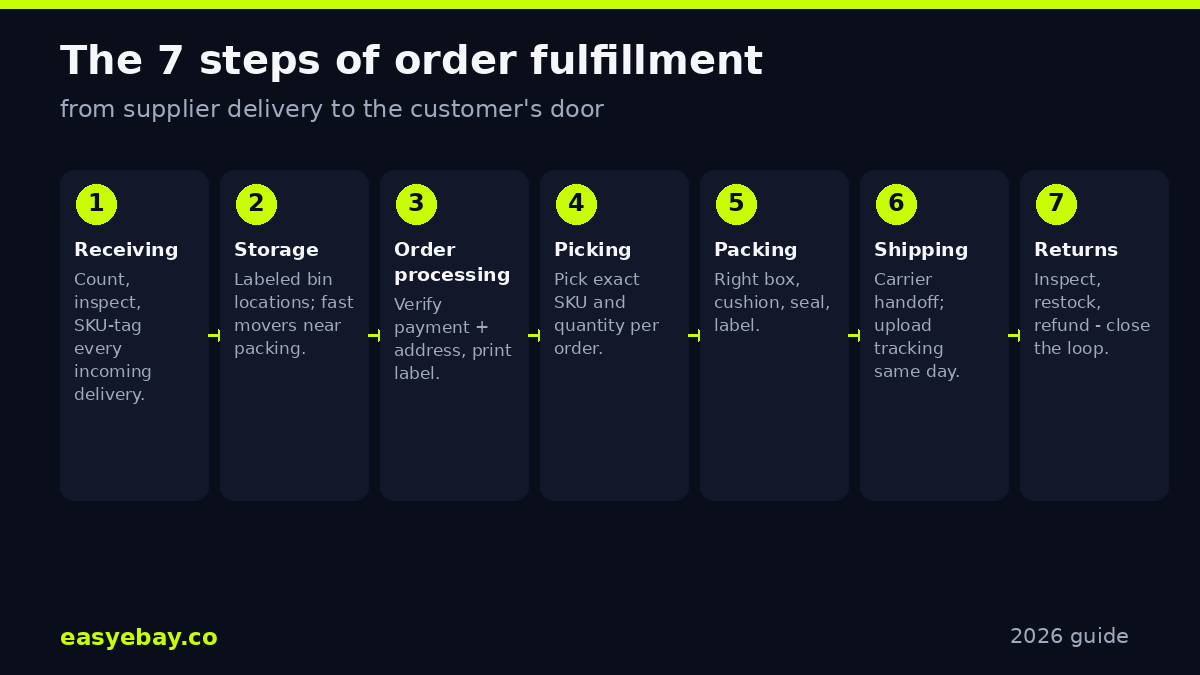
The e-commerce order fulfillment process has 7 steps: (1) receiving, (2) storage, (3) order processing, (4) picking, (5) packing, (6) shipping, (7) returns. Every order passes through these seven stages in sequence, whether you fulfill from home or through a logistics partner. A bottleneck in any one of them delays everything downstream.
Each step of the e-commerce order fulfillment process below covers what happens, what typically goes wrong, and who is responsible for preventing it.
Step 1: Receiving Inventory
Receiving is the intake of stock from your supplier into your fulfillment location. Count every incoming shipment, inspect it for damage, and check it against the purchase order before it enters your sellable inventory.
This sounds basic, but skipped receiving checks are how sellers end up with 100 units on the shelf when their system thinks they have 120. The resulting oversells create cancelled orders, refunds, and angry customers.
Assign an SKU to every product upon receipt. Photograph damaged units immediately for supplier claims, and never list uncounted stock.
If you source from wholesale markets in Pakistan, also verify the variant, size, and color mix; busy market suppliers routinely substitute.
Step 2: Inventory Storage
Once received, put the inventory away in organized storage locations, such as shelves, bins, or warehouse slots. Map each SKU to its location in your system.
Organized storage is what makes the later picking step fast and accurate. The professional standard is a bin location system. Every product lives at a labeled address (e.g., Aisle 3, Rack B, Bin 12), so anyone can find any item without hunting.
For home-based sellers, that means labeled boxes or shelf zones, not one big pile. Keep fast-moving items near the packing station, heavy items at waist height, and fragile items in protected zones.
Mixed-up similar products are a top cause of picking errors.
Step 3: Order Processing
Order processing begins the moment a customer pays. Your store or marketplace captures the order.
You verify it (payment confirmed, address complete, no fraud flags) and release it to the fulfillment queue. This step also includes printing the shipping label and packing slip.
Your "handling time" (payment to shipment) starts ticking now. Marketplaces base estimated delivery dates on it.
Process within 24 hours, and you can promise faster delivery than a seller who batches twice a week. Screen for fraud here, too: shipping a high-value order to an incorrect address without verification costs you both the product and the payment.
Step 4: Picking
Picking is the process of retrieving the ordered items from storage. The picker follows a pick list (paper or handheld scanner), goes to each bin location, and collects the exact SKU and quantity.
Picking is the single biggest source of fulfillment errors: grabbing the wrong variant, size, or quantity.
Beginners pick one order at a time (discrete picking). As volume grows, batch picking (many orders per aisle trip) and zone picking cut walking time, which dominates picking labor cost.
The cheapest upgrade in accuracy is barcode scanning at the pick location. Scanning shelf and item barcodes catches the wrong item error before it leaves the warehouse, not after the customer opens the box.
Step 5: Packing
Packing is placing picked items into the shipping container with protective material. You add the packing slip and any inserts, seal the box, and attach the shipping label.
Good packing balances protection, presentation, and dimensional weight. The item must survive the courier network. Branded or neat packaging stands out in reviews and unboxing posts. And couriers charge by size as well as weight, so oversized boxes inflate shipping costs.
Common failures: oversized boxes (leading to higher courier charges and items rattling and breaking), missing packing slips, and weak sealing on heavy parcels.
Rule of thumb: the box should fit the item plus ~5 cm of cushioning per side. The label must stay legible; cover it with clear tape if your printer ink smudges.
Step 6: Shipping
Shipping is handing the packed parcel to the carrier and getting it moving through the delivery network to the customer.
This step includes carrier selection, rate shopping, label generation, pickup or drop-off scheduling, and communication of the tracking number to the buyer. Upload the tracking number to the order promptly; on marketplaces, uploading tracking on time is part of your seller performance metrics.
Choose couriers on cost versus reliability per parcel, not loyalty. Keep accounts with two or more and route by destination, weight, and urgency.
Pakistani sellers can compare TCS, Leopards, PostEx, BlueEx, and Pakistan Post domestically. DHL, FedEx, and UPS dominate international routes, with freight forwarders consolidating heavier loads.
Insure high-value parcels and photograph each packed parcel before handoff; that photo is your damage claim evidence.
Step 7: Returns Processing
Returns processing, reverse logistics, is receiving the returned item, inspecting its condition, restocking it (or writing it off), and issuing the refund or replacement.
Returns are part of the e-commerce order fulfillment process, not an afterthought. Industry surveys consistently report online return rates of roughly 20-30% in categories such as fashion. Every return handled slowly or rudely burns a customer relationship.
A clear return policy reduces return losses, and customers who know the rules file fewer disputes.
Inspect returns within 48 hours, refund within your stated window, and track reasons. If 15% of returns on one product say "not as described," fix the listing photos and description, not the warehouse.
| Step | What happens | Who owns it | Most common failure |
|---|---|---|---|
| 1. Receiving | Count, inspect, and SKU tag incoming supplier stock | You or warehouse inbound team | Uncounted stock → phantom inventory → oversells |
| 2. Storage | Put away in labeled bin locations | You or warehouse team | Mixed up similar products → wrong picks |
| 3. Order processing | Verify payment/address, print label and slip | You or order management system | Slow handling → missed delivery promises |
| 4. Picking | Collect exact SKU and quantity from bins | Picker/warehouse staff | Wrong variant or quantity shipped |
| 5. Packing | Box, cushion, seal, label | Packer | Oversized box (cost) or weak protection (damage) |
| 6. Shipping | Hand to carrier, upload tracking | You or 3PL | Late tracking upload → account defect |
| 7. Returns | Inspect, restock or dispose, refund | You or returns team | Slow refunds → chargebacks and bad reviews |
What Are the Types of Fulfillment?
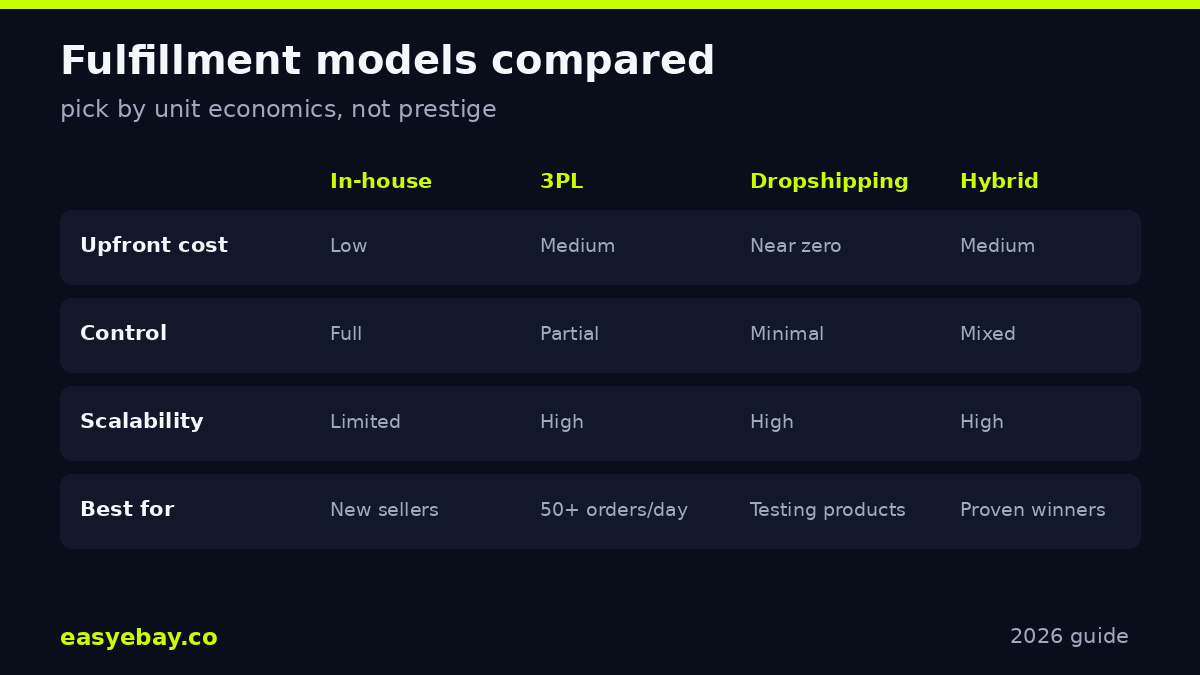
The main types of fulfillment are in-house, third-party logistics (3PL), dropshipping, and hybrid. In-house means you store, pick, pack, and ship everything yourself. 3PL means a logistics company fulfills orders for a per-order fee. Dropshipping means the supplier ships directly to your customer. Choose based on order volume, capital, and the level of control you want.
No model is universally best, only best for your current stage. Most sellers start in-house or with dropshipping, move to 3PL when self-fulfillment becomes a full-time job, and often land on a hybrid model.
In-house fulfillment gives maximum control and the lowest per-order cost at a small scale, since you pay no one else's margin. The trade off is your time.
Around 20 to 50 orders a day; packing takes up the whole day. That leaves nothing for sourcing or marketing, and your cash sits in inventory on your own shelves.
Third-party logistics (3PL) means shipping inventory in bulk to a fulfillment company's warehouse. They handle storage, picking, packing, and shipping, usually with software that syncs with your store.
You pay for storage plus a per-order pick-and-pack fee. You get instant scale without hiring staff, but less packaging control, and the fees only work once your volume and margins absorb them. Pakistani sellers targeting the US or UK often use American or British 3PLs for 2 to 5-day domestic delivery.
See Shopify's guide on how to choose a 3PL partner.
Dropshipping means never holding inventory: you forward each order to the supplier, who ships directly to the customer. Startup cost is near zero, and product testing is fast.
The trade-offs: thin margins, zero control over packaging and shipping speed, and full responsibility for complaints about shipments you never touched. Long overseas shipping times are a classic failure point; customers who wait three weeks rarely return.
Hybrid is the pragmatic middle. Hold your bestsellers in-house or with a 3PL for fast, controlled delivery, and dropship slow-moving or bulky items you don't want to stock. Many experienced sellers run exactly this split without ever naming it.
| Model | Upfront cost | Control over quality | Scalability | Best for |
|---|---|---|---|---|
| In house | Low (your space + materials) | Full, you touch every parcel | Limited by your time and space | New sellers, under ~30 orders/day |
| 3PL | Medium (bulk inventory + fees) | Partial, set standards in an SLA | High, warehouse scales for you | Growing stores, 50+ orders/day |
| Dropshipping | Near zero | Minimal, supplier ships your brand's promise | High for product testing | Testing products, zero capital starts |
| Hybrid | Medium | High on stocked items, low on dropshipped | High | Sellers with a few proven winners |
Decide on unit economics, not prestige. Calculate true per-order cost under each model, including packaging, courier fees, storage, labor (valuing your own hours honestly), and error costs, and pick where the numbers work.
Choosing a 3PL for the image when margins can't cover the pick-and-pack fee means working with your logistics provider.
How Do I Fulfill Orders?
To fulfill orders, set up a repeatable daily workflow. (1) Pull orders, (2) verify payments, (3) print labels in bulk, (4) pick items. (5) Pack with a standard kit, (6) hand parcels to the courier on schedule, and (7) upload tracking numbers. Run this ecommerce order fulfillment process checklist daily. Quality comes from routine, not heroics.
Starting from zero, the practical setup is simple. First, SKU-tag every product and variant, and store inventory in labeled zones, even if "zones" means cartons on shelves.
Second, standardize one packing station: your 3 to 4 most used box sizes, cushioning, tape gun, scale, printer, and poly mailers. A kitchen scale works for light parcels. Overcharges from guessed weights are a classic beginner leak.
Third, open accounts with at least two domestic couriers and compare rates for your typical parcel weight. Rates vary significantly, and a backup protects you during service disruptions.
Fourth, set a daily cutoff (e.g., orders placed before 3 PM ship the same day) and a daily pickup slot, so you can advertise honest handling times.
Fifth, build the paper trail habit from day one. Every parcel gets a tracking number, which is uploaded to the order the same day and logged with the date, order ID, courier, and status.
When a customer asks, "where is my order," the log answers in seconds. This prevents most "item not received" disputes from escalating.
As volume grows, the fastest paying upgrades are barcode scanning and negotiated courier rates. Discounts kick in with consistent daily volume. Eventually, use a 3PL when packing takes more than half your day.
What Is a Good Order Fulfillment Rate?
A good order fulfillment rate, the share of orders shipped complete, accurate, and on time, is 98% or higher. Best in class operations hit 99.5%+. Calculate it as (orders shipped on time and complete ÷ total orders) × 100. Below 95%, errors and delays pile up enough to damage reviews and trigger marketplace penalties.
But the headline rate is only one of several KPIs worth tracking. Measure these monthly from the start, even in a spreadsheet, and you'll spot problems while they're cheap to fix.
| KPI | Formula | Healthy target | What it tells you |
|---|---|---|---|
| Order fulfillment rate | (On time, complete orders ÷ total orders) × 100 | ≥ 98% | Overall reliability of your operation |
| Order accuracy rate | (Error free orders ÷ total orders) × 100 | ≥ 99% | Picking and packing quality |
| On time shipment rate | (Orders shipped by promised date ÷ total orders) × 100 | ≥ 98% | Whether your handling time promises hold |
| Average fulfillment time | Total hours from order to shipment ÷ orders | < 24 hours | Speed of your internal process |
| Return rate | (Returned units ÷ shipped units) × 100 | < 10% (varies by category) | Product/listing quality signal |
| Inventory accuracy | (System stock count ÷ physical count) × 100 | ≥ 97% | Whether your stock records are trustworthy |
| Cost per order fulfilled | Total fulfillment cost ÷ orders shipped | Trending down as you scale | Whether operations are getting more efficient |
Two caveats: category matters. Fashion and footwear routinely see 20 to 30% return rates in industry surveys, so 15% there is normal but alarming for phone accessories.
And never chase speed by skipping verification: shipping fast but wrong costs you return shipping, a replacement, and the review.
What Packaging and Shipping Options Should I Use?
Match packaging to the product: poly mailers for soft, non-fragile goods; corrugated boxes with cushioning for fragile or multi-item orders. Choose the courier by destination, weight, and promised date. Aim for the cheapest combination that still delivers undamaged and on time. Damaged arrivals cost far more than good boxes.
Shopify's shipping operations guide covers the pick, pack, and weigh sequence in detail.
Packaging options compared:
| Option | Best for | Rough cost logic | Watch out for |
|---|---|---|---|
| Poly mailer | Clothing, soft goods, non fragile items | Cheapest; lightweight, low dimensional weight | No protection for fragile items |
| Single wall corrugated box | Most general products | Affordable; fine for sturdy goods | Crushes under heavy stacking |
| Double wall corrugated box | Heavy or fragile items | Higher cost, much stronger | Overkill (and costly) for light goods |
| Bubble wrap / honeycomb paper | Cushioning inside boxes | Small per order cost | Skipping it to save pennies causes damage claims |
| Branded box or insert | Repeat purchase products | Adds cost per order | Only worth it once unit economics allow |
Shipping options compared:
| Option | Best for | Trade off |
|---|---|---|
| Standard domestic courier | Everyday orders within the country | Balanced cost and speed; your default |
| Express / overnight | Urgent orders, premium customers | Expensive; offer as a paid upgrade, not the default |
| Economy / postal service | Low value, non urgent parcels | Cheapest but slowest and harder to track |
| International express (DHL, FedEx, UPS) | Cross border orders | Fast and reliable; cost only works on higher margin items |
| Freight forwarder / consolidation | Heavy or bulk international shipments | Cheapest per kg at volume; slower, more paperwork |
Build average shipping cost into your product price where the market allows and advertise delivery as fast or free. Shoppers abandon roughly 7 in 10 carts overall, with unexpected shipping costs consistently cited as the top reason.
A slightly higher price with "free shipping" almost always converts better than a low price plus a shipping surprise.
What Mistakes Cause Late or Wrong Deliveries?
The mistakes behind late or incorrect deliveries include overselling due to inaccurate inventory, picking errors caused by disorganized storage, underestimated handling time, choosing couriers on price alone, skipping tracking uploads, and neglecting returns. Nearly every fulfillment disaster traces to one of these six.
| Mistake | What it costs you | The fix |
|---|---|---|
| Phantom inventory (system says in stock, shelf is empty) | Cancelled orders, refunds, marketplace defects | Count at receiving; cycle count top SKUs weekly |
| Disorganized storage, similar products mixed | Wrong items shipped; return shipping + reship cost | Bin locations + barcode scanning at pick |
| Promising same-day handling, you can't sustain | Late shipment rate penalties, bad reviews | Set handling time, you can hit 99% of days, then beat it |
| Cheapest courier for every parcel | Lost parcels, no tracking, damage with no recourse | Two courier setup; match service level to order value |
| Forgetting to upload tracking numbers | "Item not received" cases you can't win | Same day tracking upload as a non-negotiable checklist step |
| Treating returns as an afterthought | Chargebacks, 1 star reviews, repeat buyer loss | 48 hour inspection rule; track return reasons per product |
One structural mistake: scaling marketing before operations. Ads that double orders when fulfillment breaks at 1.5× volume manufacture a wave of late, wrong shipments.
This tank's ratings are exactly when visibility peaks. Build fulfillment headroom before buying growth.
Frequently Asked Questions
What are the 7 steps of order fulfillment?
The 7 steps are receiving inventory, inventory storage, order processing, picking, packing, shipping, and returns processing. Every order moves through these stages in sequence, whether you fulfill from home or through a 3PL warehouse.
Which is the first step of order fulfillment?
Receiving is the first step: counting and inspecting incoming supplier stock and adding it to inventory. Skipping proper receiving creates phantom inventory; your system shows stock you don't have, which leads to oversells and cancelled orders.
What are the steps in the order fulfillment process in order?
In order: (1) receive inventory from suppliers, (2) store it in organized bin locations. Then (3) process incoming orders (verify payment and address, print labels), (4) pick items from storage.
(5) pack them with protection and labeling, (6) ship via the chosen carrier and share tracking, (7) process any returns.
What are the types of fulfillment?
The four types are in-house (you do everything yourself), 3PL (a logistics company fulfills for you), dropshipping (the supplier ships directly to your customer), and hybrid (a mix, e.g., bestsellers in-house, slow movers dropshipped).
What is the difference between in-house, 3PL, and dropshipping fulfillment?
In-house gives full control at the cost of your time; 3PL gives professional scale for a per-order fee with less control.
Dropshipping needs no inventory but offers thin margins and no control over shipping speed or packaging. Choose based on your per-order unit economics, not prestige.
What is a good order fulfillment rate?
98% or higher, with best-in-class operations above 99.5%. Below 95%, error and delay volumes start to damage reviews and can trigger marketplace account penalties. Track it alongside order accuracy (target: 99%+), and on-time shipment rate (target: 98%+).
How do I fulfill orders as a beginner?
Pull daily orders, verify payments and addresses, and print labels in bulk. Pick with a printed list, pack at a standardized station, hand parcels to the courier on a fixed daily schedule, and upload tracking numbers the same day.
Open accounts with two couriers, set an honest handling time, and keep a shipment log from day one.
How long should order fulfillment take?
Aim to ship in-stock items within 24 hours of payment. Industry surveys consistently show that delivery speed strongly influences buying decisions. Marketplaces reward sellers with short, reliable handling times through better search placement and buyer trust badges.
Further Reading
Free Download
Payoneer And eBay Setup Checklist
24 simple steps to open, verify and link your accounts the right way. Free PDF, made by Asad.
Want Help With Your Store?
Book a free call with Asad Shahzad.
Book A Free Call
Asad Shahzad | Founder and Mentor
Asad Shahzad is the Co Founder and Co Mentor of EasyEbay. He helps store owners manage accounts and grow sales.
Read more from Asad ShahzadRelated Topics
How Much Can You Earn in Pakistan from Walmart, Temu, Shopify, TikTok Shop and Vinted?
There is no fixed monthly income on Walmart, Temu, Shopify, TikTok Shop or Vinted, and from Pakistan some of these platforms are not even open to you yet. This guide shows what your earnings really depend on, how to estimate an honest number for yourself, and why big sales screenshots prove so little.
How to Handle Customer Messages Like a Pro (With Reply Templates)
Learn how to handle customer messages on eBay, Amazon, Etsy and other marketplaces with simple rules, a daily routine, and polite reply templates you can copy.
Daraz vs eBay, Amazon and Other Marketplaces: Where Should Pakistani Sellers Sell?
Is eBay better than Daraz for Pakistani sellers? An honest comparison of Daraz, eBay, Amazon, Walmart, Etsy, Shopify, TikTok Shop, Temu and Vinted, covering buyers, fees, payments and who can join.